# Setting up Automation
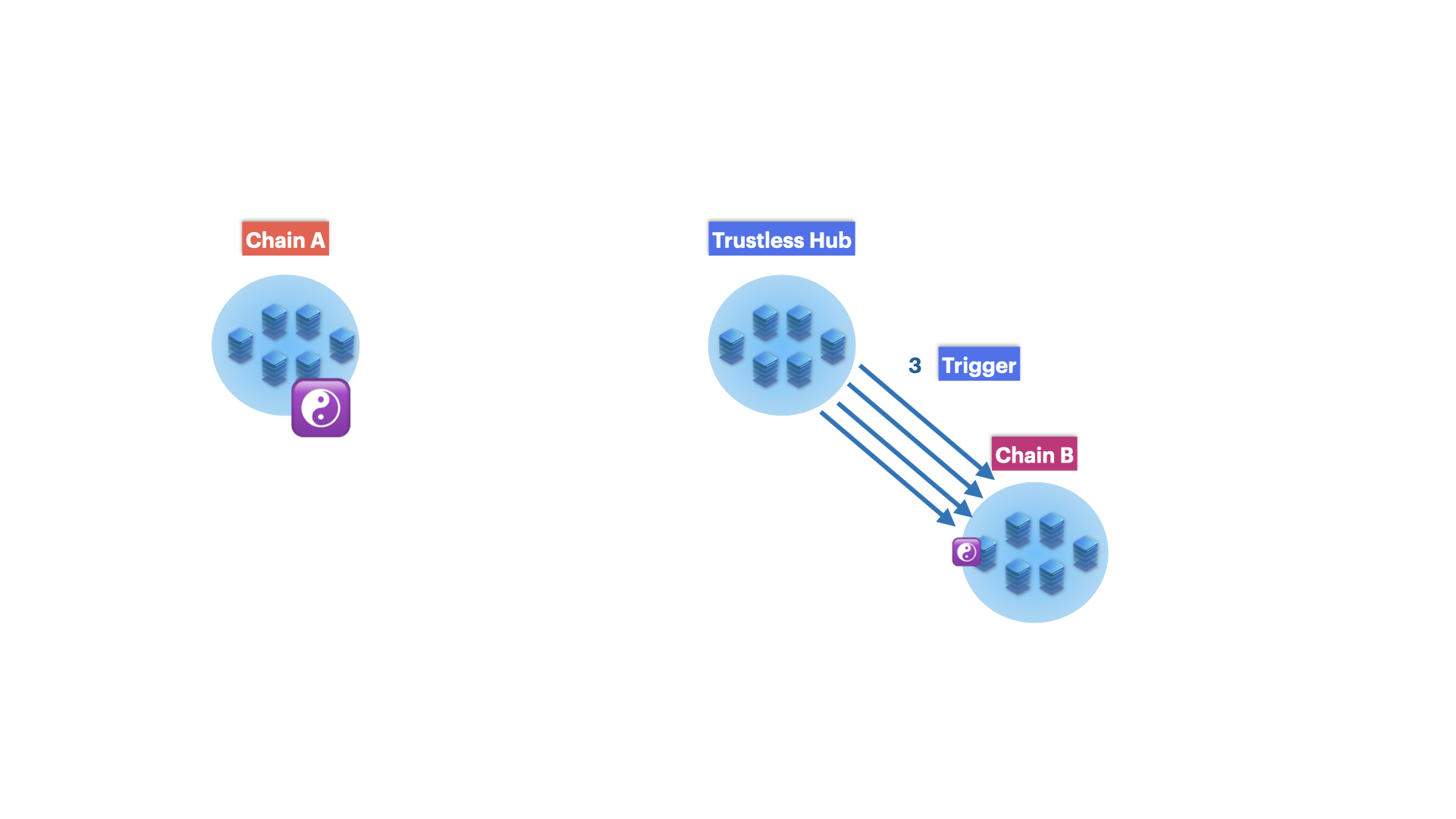
In the previous step we showed how the trigger process looks like by submitting an AutoTX on Trustless Hub. You can do this with the TriggerPørtal interface, a TrustlessJS front-end integration or locally through the CLI.
In addition, you can also submit an AutoTX from another chain using the ICS20 standard (opens new window).
# Automation for DAOs
Setting up a trigger on a different source chain than Trustless Hub can be particularly useful for DAOs. Using this middleware, DAOs can now automate tasks not only on the source chain but also on different destination chains. DAOs can automate periodic token swaps, payroll, payment in installments amongst other scheduled actions. These can be performed in one proposal, which normally require periodically voting on individual proposals. This requires manual action from the proposer and DAO participants.
With automation over Trustless Hub, this can be simplified to one proposal. In addition, DAO participants do not need to worry about immediate changes in the liquidity position of the DAO, as the DAO does not need to move funds to a smart contract upon the vote.
# ICS20 Middleware
ICS20 is the interchain standard that enables the transfer of fungible tokens between independent blockchains within the Cosmos ecosystem. It is a protocol that defines a standard interface for token transfers across different blockchains that implement the Inter-Blockchain Communication (IBC) protocol.
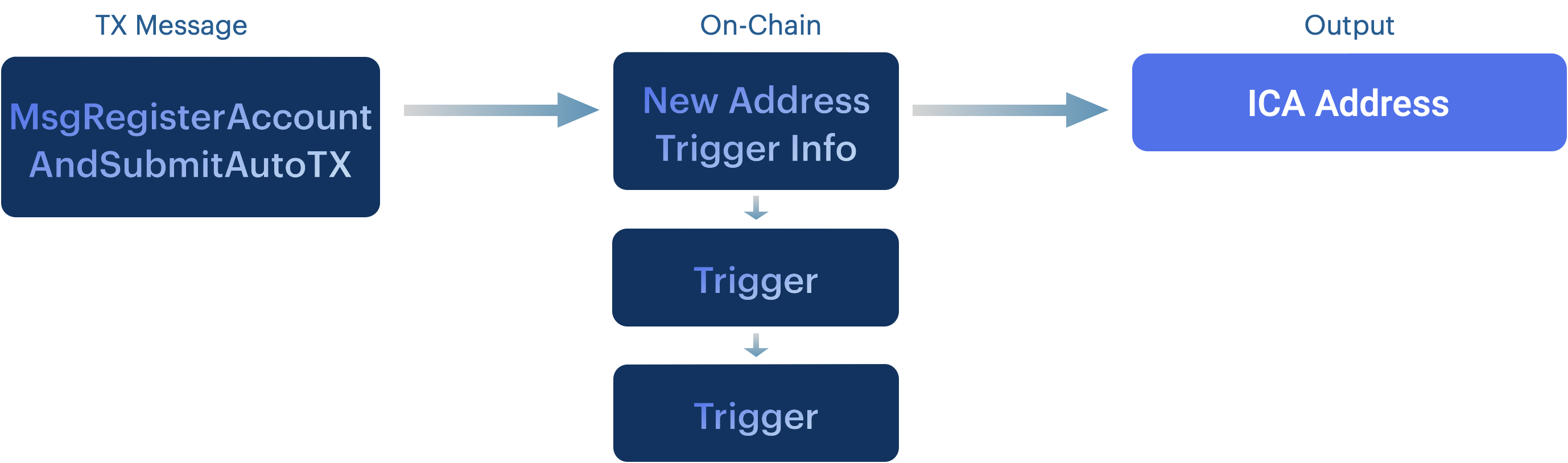
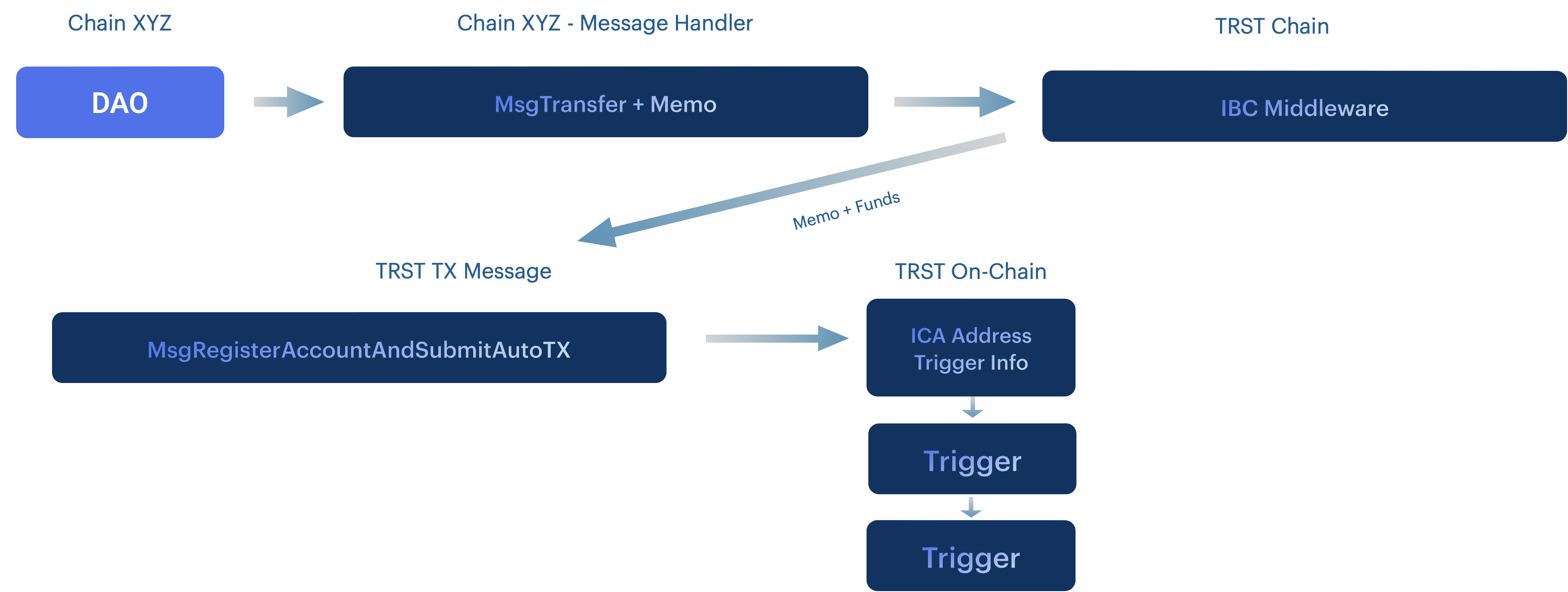
With ICS20 transfer middleware, you send a transfer with a memo on a chain, and Trustless Hub will convert this ICS20 message to an AutoTx trigger submission. Using an ICS20-standard transaction, accounts on other chains can create triggers. A MsgRegisterAccountAndSubmitAutoTx or a MsgSubmitAutoTx can be derrived from the memo field in the ICS20 transfer message.
Our custom middleware is loosely based on the wasmhooks implementation on Osmosis (opens new window).
The mechanism enabling this is a memo field on every ICS20 transfer packet as of IBC v3.4.0 (opens new window).
ics_middleware.go is IBC middleware that parses an ICS20 transfer, and if the memo field is of a particular form, it creates a trigger by parsing and handling a SubmitAutoTx message.
These are the fields for auto_tx that are derived from the ICS20 message:
- Owner: This field is directly obtained from the ICS20 packet metadata and equals the ICS20 recipient. If unspecified, a placeholder is made from the ICS20 sender and channel.
- Msg: This field should be directly obtained from the ICS20 packet metadata.
- FeeFunds: This field is set to the amount of funds being sent over in the ICS20 packet. One detail here is that the denom in the packet is the source chains representation of the denom, this will be translated into TRST on Trustless Hub.
The constructed message for MsgSubmitAutoTx will contain the following:
# ICS20 packet structure
So given the details above, we propogate the implied ICS20 packet data structure. ICS20 is JSON native, so we use JSON for the memo format.
An ICS20 packet is formatted correctly for submitting an auto_tx if the following all hold:
memois not blankmemois valid JSONmemohas at least one key,"auto_tx"memo["auto_tx"]["msgs"]is an array with valid JSON SDK message objects with a key "@type" and sdk message valuesreceiver == memo["auto_tx"]["owner"]. Optional, an owner can be specifed and is the address that receives remaining fee balance after execution ends.memo["auto_tx"]["cid"]is a valid connection ID on TRST -> Destination chain, omit it for local TRST execution of the message.memo["auto_tx"]["register_ica"]can be added, and true to register an ICA.
Fees are paid with a newly generated and AutoTX specific fee account.
If an ICS20 packet does not contain a memo containing "auto_tx", a regular MsgTransfer takes place. If an ICS20 packet is directed towards AutoTX, and is formated incorrectly, then it returns an error.
# Example: DAO Integration
Using ICS20 to set up a Trustless Trigger is for advanced users that are familiar with terms such as ICS20 transfers and Authz permissions.
Our ICS20 middleware is developped to allow DAOs to perform time-based actions. These can be executed locally on Trustless Hub, a destination chain which can also be the source chain.
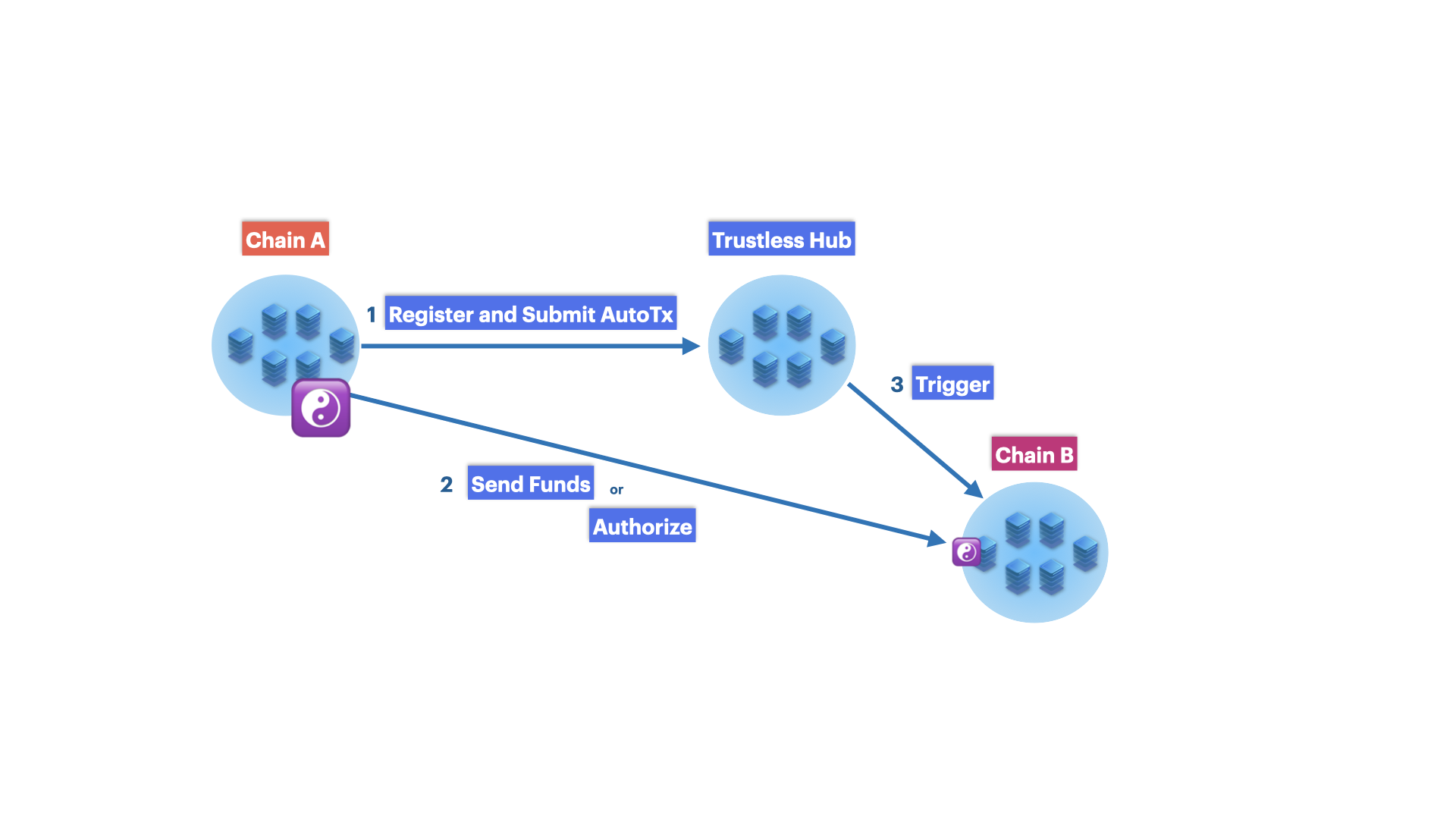
There are several caveats to using ICS20 to set up a trigger. When automating on a destination chain for the first time, not one but two transactions is required to activate the trigger. One transaction is to set the trigger and create an Interchain Account at Trustless Hub and another is to set permissions/send funds to the Interchain Account on the destination chain.
To demonstrate how DAOs can integrate with Trustless Triggers we explain the process using an example.
DAO wants to pay Service provider ABC for their services that they provide on a monthly basis in TOKEN1 and holds TOKEN2 and JUNO.
Service provider ABC invoice example 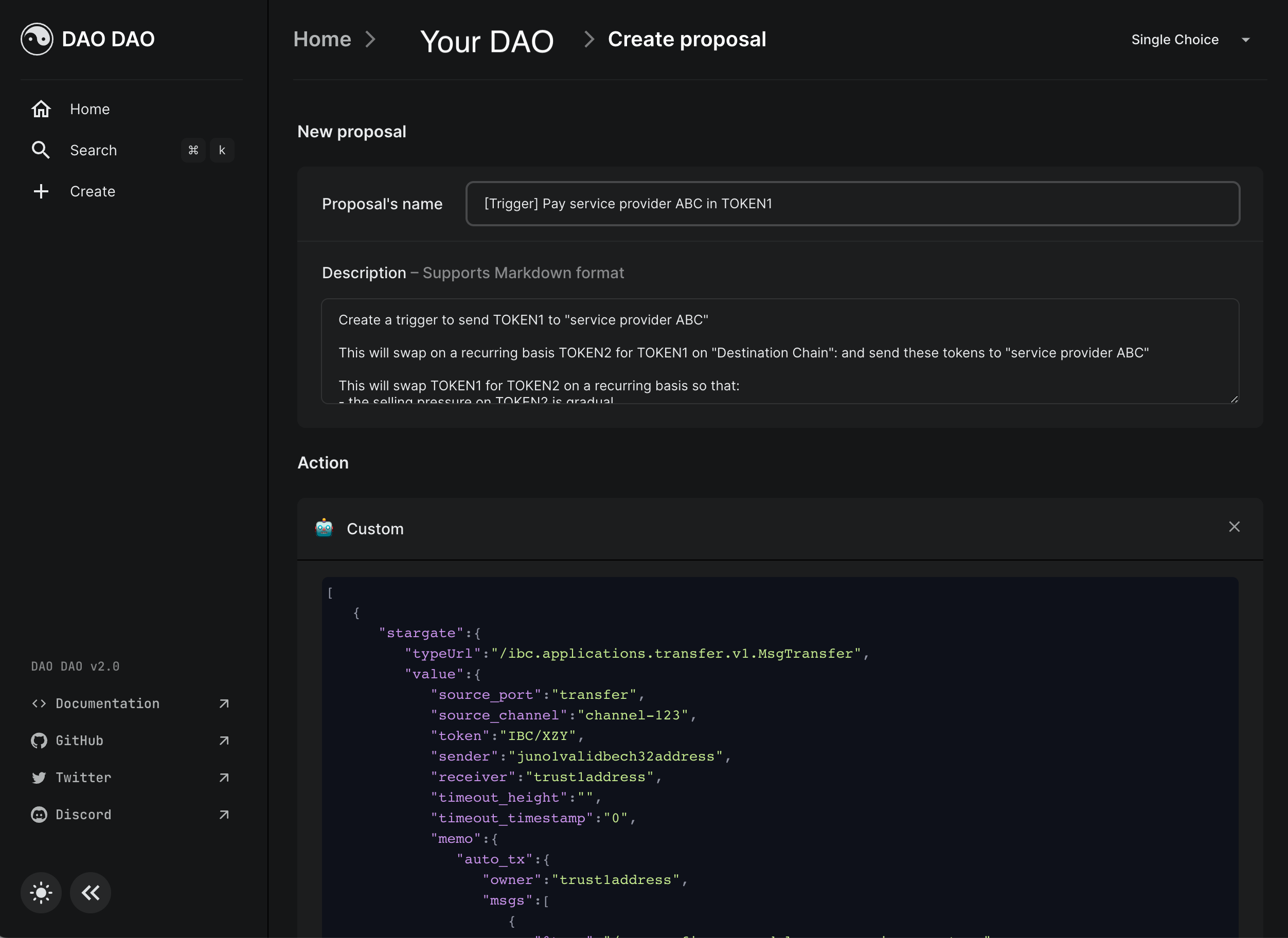
In this example a DAO on DAODAO triggers a swap of TOKEN2 for TOKEN1 on dex "DEX" on a recurring basis.
Then it can automatically send these tokens to Service provider ABC.
This is a neat use case for Trustless Triggers as it requires movement from assets between chains and accounts. The tokens to send can remain in control of the DAO.
As Trustess Triggers are on-chain, the process can be done completely without trusted third parties.
The DAO can appoint an owner that can manage the trigger or use a placeholder account on Trustless Hub to remain in full control.
For this invoice example we have the following proposal name and description:
Example Proposal name
Example Description
Having adequate liquidity is crucial to ensure smooth operations and financial stability. It enables you to fulfill your financial obligations to suppliers, lenders, and other stakeholders, which strengthens your credibility and reputation in the marketplace. With sufficient liquidity, you can easily pay for bills and expenses, invest in growth opportunities, and effectively manage your DAO's resources. Thus, prioritizing and managing liquidity effectively can help you achieve long-term success and sustainable growth.
# 1. Submitting AutoTX
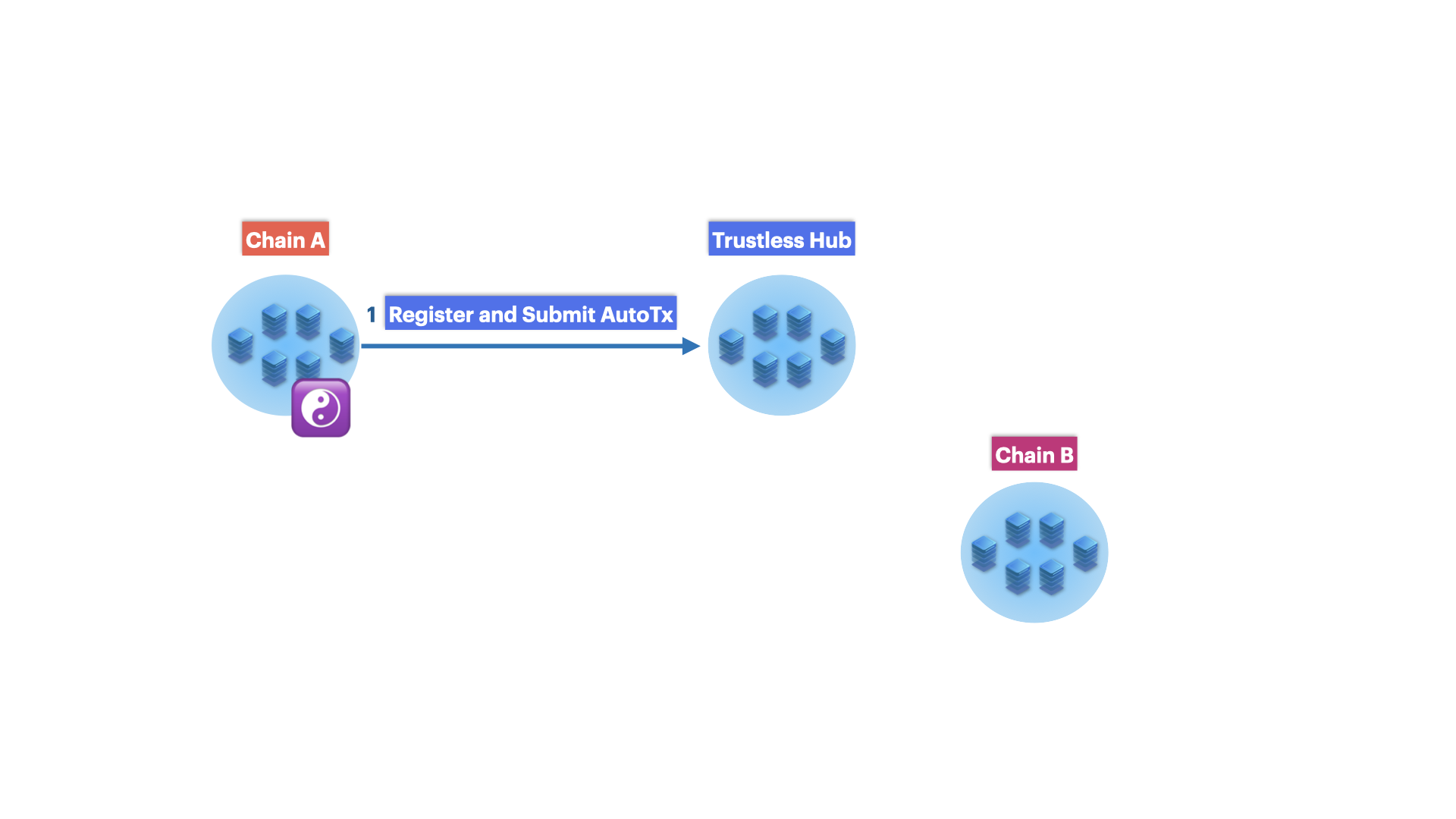
Submit a proposal with a custom message to execute. For a CosmWasm-based DAO like DAO DAO (opens new window) DAOs on Juno, This message contains the ICS20 messageMsgTransfer. In the memo you provide the AutoTx details such as the messages to automate, time parameters and set a custom label.
Below is how the proposal action message could look like for a CosmWasm-based DAO:
Here it is important that the timeout_timestamp or timeout_height takes into account the proposal's end time. Alternatively both of the timeout values can be set to 0.
Further it is important that the field register_ica is set to "true" the first time you create an AutoTX. This will register an Interchain Account from Trustless Hub on the destination chain.
A message in the auto_tx["msgs"] array can be like the following MsgSend:
For the DAO service provider example, we can have a SwapAndSendTo (opens new window) in a MsgExecuteContract (opens new window) message to swap TOKEN2 for TOKEN1 locally on Juno. We can specify the out recipient the recipient's address.
write `ICA_ADDR` as a `grantee` or any other field in the message and Trustless Hub will parse the to-be defined Interchain Account address. This is transformed when the first execution happens.
Alternatively, we can perform MsgSwapExactAmountOut (opens new window) to Osmosis given that there are funds on the DAO's TrustlessHub-Osmosis Interchain Account on Osmosis. To send funds for execution, the DAO can make a proposal for MsgTransfer that funds the Trustless Hub Interchain Account. The DAO then controls a trigger on Trustless Hub that controls the swap.
# 2. Setting Up Permissions and Funds
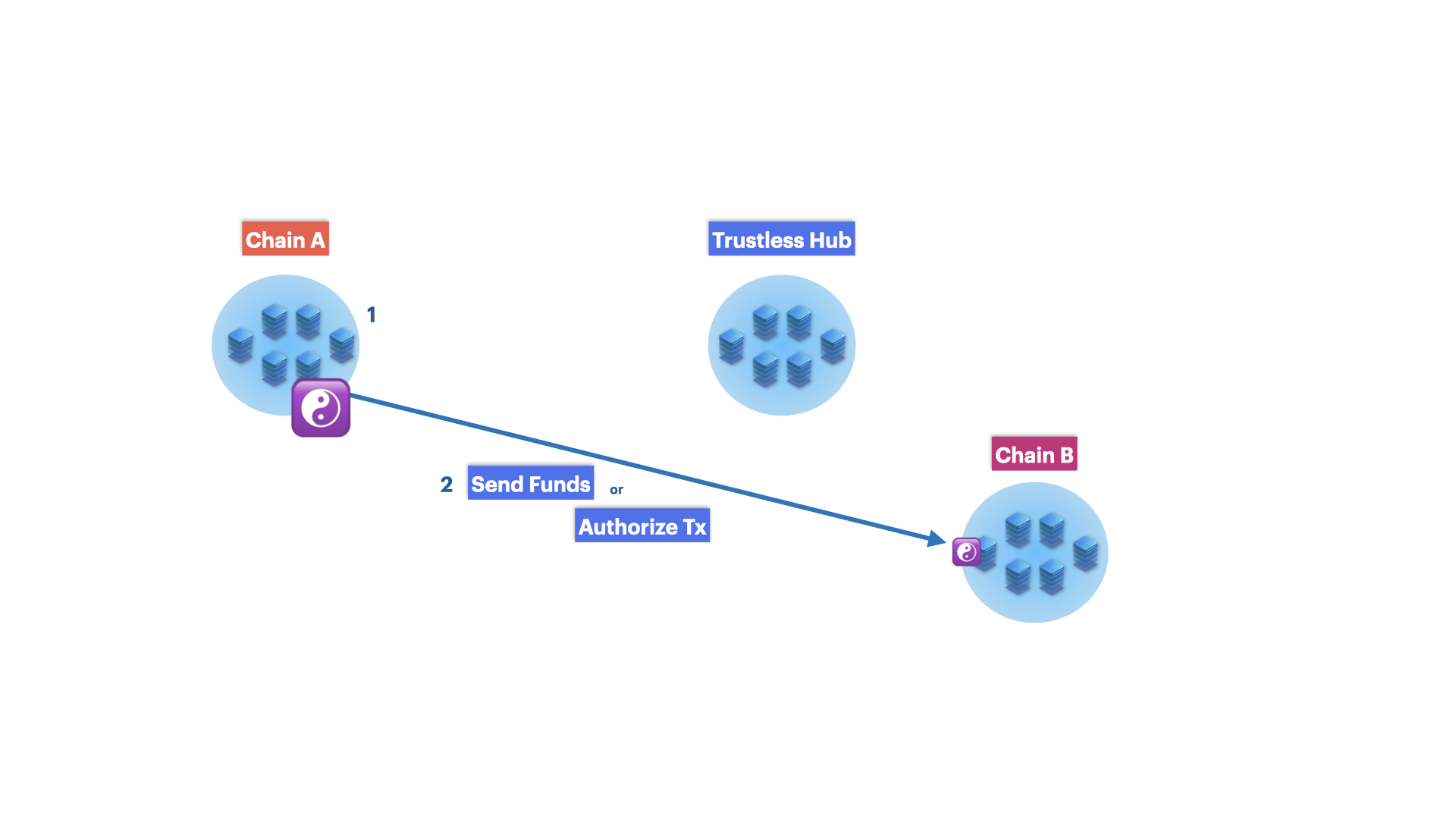
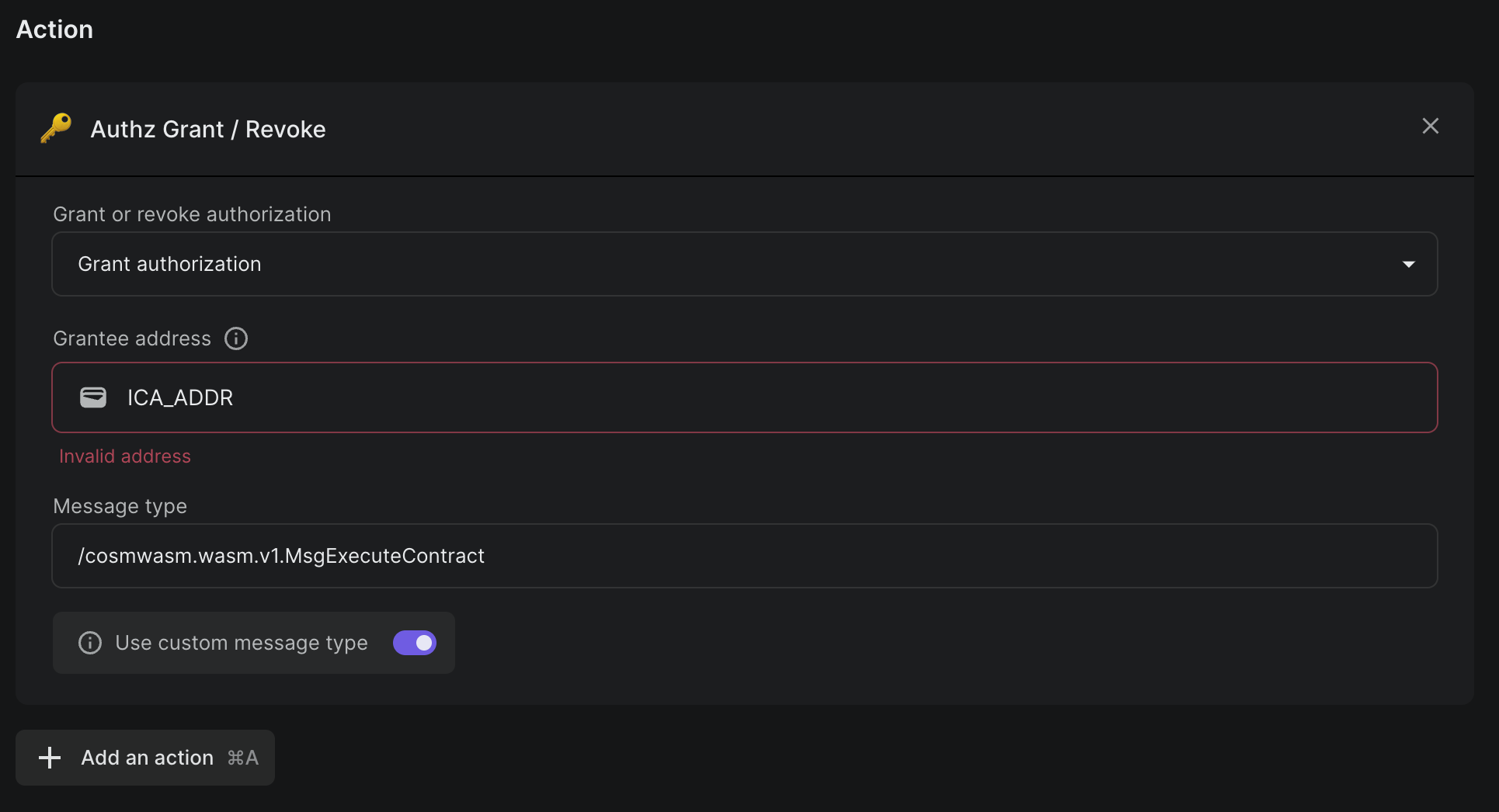 Proposal 2 can be the following and should contain the ICA_ADDR, which can found by querying the interchain account address.
The ICA_ADDR should also have some funds to execute and have the proper permissions set up
write ICA_ADDR as a `sender` or any other field in an AutoTX and Trustless Hub will parse the to-be defined Interchain Account address.
# Sending funds
Trigger fees, or 'AutoTx fees on Trustless Hub are paid from the funds sent in the ICS20 message.
Execution on Trustless Hub
If you want to execute messages locally on Trustless Hub, set auto_tx["connection_id"] to "". The funds sent with the ICS20 transfer will be used to pay for AutoTx fees. For local transactions there is no additional fee charged.
With execution over IBC
To execute triggers succesfully on destination chain, the ICA on the destination chain should be funded with destination chain's fee token.
Fees can be funded by directly sending tokens to the ICA on destination chain by a DAO member before the first execution starts.
A trustless approach is available too. You can submit an additional proposal to send MsgTransfer to destination_chain with the destination_chain_ica_address as the receiver.
For the DAO example, a similar proposal to the above can be sent. This does not take a memo. Here's an example:
Alternatively, if the destination chain is the same as the source chain, the DAO can create a FeeGrant for the `destination_chain_ica_address`.
# Setting permissions
Alternatively, you can create a FeeGrant for the destination_chain_ica_address when the DAO is present on destination chain. You can also allow the ICA address to execute transactions for the DAO using AuthZ. Here (opens new window) is an article explaining the power of both FeeGrant and AuthZ.
Initiating a trigger for the first time locally on Juno can be done as follows:
- Proposal 1 Message 1: IC20 token tranfser: Submit AutoTX on Trustless Hub. In the
auto_txmemo,msgsshould contain AuthZ's MsgExec withMsgExecuteContract. - Proposal 2 Message 1: Allow the DAO's JUNO tokens to be used for fees by
destination_chain_ica_addresswith a FeeGrant.
Proposal 2 Message 2: AuthZ grant to ICA to executeMsgExecuteContract.
For a DAO swapping tokens on a recurring basis on Osmosis for the first time, 2 proposals should be made.
- Proposal 1 Message 1: IC20 token tranfser: Submit AutoTX on Trustless Hub. In the
auto_txmemo,msgsshould contain AuthZ's MsgExec withMsgSwapExactAmountOut - Proposal 2 Message 1: Send OSMO tokens to using
MsgTransfertodestination_chain_ica_address.
Proposal 2 Message 2: AuthZ grant to ICA to executeMsgSwapExactAmountOut.
Only one proposal action containing the auto_tx memo has to be specified, when the funds and grants are in place from a previous action on that particular Interchain Account.
Setting up a trigger from one chain to another is a lengthy process which may be difficult to understand for end-users. The process can be simplified in the future, by creating abstractions of the actions in DAO tooling such as DAODAO.
# 3. Managing Triggers
On TriggerPørtal (opens new window), you can view, manage and create triggers.